Blog  |   Puzzles  |   Books  |   About

Utility is overrated.

June 24th, 2007


There are few questions that suck the joy out of a room faster than this one:

“What good is it?”

As the creator of innumerable software toys that serve no useful function, I find this type of question, and its close relatives (which include “what did you make that for?”, “how are you gonna monetize that?” and “so?”) a little vexing. These questions are the blunt weapons of the unimaginative.

A question like “what good is it?” presupposes that all things must serve some common good. They must save lives, or repair toasters, or solve the world’s fuel shortages, or above all, make enormous sums of money. In short, everything must have a use, and frivolity should be avoided.

Personally, I think utility is overrated.

It is this overrated notion of utility that separates arts from crafts. A work of art will not save the world, a work of art will not cure any diseases, a work of art will probably not make you any money (unless you are one of a fortunate few).

Utility is also what separates the things we call toys from the things we call tools. A toy will not repair your home, balance your checkbook, or do much of anything beyond instilling a modicum of wonder and delight.

Wonder and delight is all we should require of our toys, and it is all we should require of our art.

To ask anything else is to ask for utility. And when a work of art becomes useful, it becomes a craft, or it becomes propaganda. When a toy becomes useful, it becomes a tool, or a weapon.

And a world full of nothing but tools, crafts, weapons and propaganda is a joyless world indeed.

There is a reason that joyless people are often called “tools”.

Now I have nothing against tools – they are the very things I use to make toys!

Sound and Light with jbum

May 24th, 2007

Things I talked about at last night’s Creative Talk at Yahoo! in Santa Monica, and some relevant links.

A magic trick:
http://www.krazydad.com/mindpower/

Can software make you cry?

My search for meaning in computer-generated art.


Randomness
http://krazydad.com/bestiary/bestiary_random_pixels.html
https://blog.krazydad.com/2005/05/04/three-johns-on-randomness/

Information Theory and Perception
https://blog.krazydad.com/2005/05/19/entropy-motion-graphics/
https://blog.krazydad.com/2005/08/01/information-theory-and-art/

Kaleidoscopes
https://blog.krazydad.com/2007/04/16/kaleidoscope-842/
http://krazydad.com/windows_freebies.php

Complexity without randomness
https://blog.krazydad.com/2007/04/02/fibonacci-logos/

Computer generated circular art
http://www.flickr.com/photos/krazydad/sets/95767/

Squared Circle group on Flickr
http://www.flickr.com/groups/circle/

Squared Circle Collaborative Poster Project / Creative Commons
http://www.flickr.com/photos/krazydad/sets/104096/
http://www.flickr.com/groups/circle/discuss/18002/?search=poster+commons

Bronze Shields
http://www.flickr.com/photos/krazydad/sets/98331/

Color Picker (Colr Pickr)
http://www.krazydad.com/colrpickr/

Light Organ
http://www.krazydad.com/bestiary/bestiary_phyllotaxy.html

Flickr Group Mosiacs
http://www.flickr.com/photos/krazydad/sets/95771/

Flickr Mosaic Portraits
http://www.flickr.com/photos/krazydad/sets/874417/

Time Graphs
http://www.flickr.com/photos/krazydad/sets/140323/

Flickr Hacks
http://www.amazon.com/exec/obidos/ASIN/0596102453/krazydad-20

CoverPop
http://www.coverpop.com/

Clocks / Automata
https://blog.krazydad.com/2006/01/24/the-ascent-a-wooden-clock-kit/
https://blog.krazydad.com/2006/03/20/cuckoo/

Athanasius Kircher
https://blog.krazydad.com/2006/03/04/kircherian-coverpop/
http://kirchersociety.org/

Organum Mathematicum (music algorithm from 1650)
https://blog.krazydad.com/2006/04/02/organum-mathematicum/
https://blog.krazydad.com/2006/04/10/text-to-song/

Syd (Music Synthesis software)
http://www.jbum.com/syd/

Wheel Music
https://blog.krazydad.com/2006/06/21/wheel-music/

Whitney Music Box
http://whitneymusicbox.org/

Presto!

May 13th, 2007

From my post on Geek Dad:

Doing magic with your kids is one of the more excellent things you can do as a father. For one thing, kids are a truly appreciative audience, and if you’re an amateur like me, probably the only truly appreciative audience you will ever actually get! Also, kids can be a tough audience, because they haven’t developed the preconceptions that make certain forms of misdirection more effective on adults. Finally, teaching your kids a card trick is a special bonding experience because it involves the sharing and keeping of powerful secrets.

Mindpower_exampleEvery few years I renew my casual acquaintance with conjuring. I now have a  small library of books about magic, and a case under my desk which is filled with all manner of scarves, cards, coins and secret apparatus. Because I’m a computer geek,  many of the magic tricks in my repertoire involve the computer in some way. For example,  I’ve made a number of Flash based card tricks, such as Mind Power, shown here.

My most astounding tricks, however, require that a magician be present next to the computer. One such trick is my "Bondoogle" effect, which you can read about on my website.

Most of the card tricks performed by professional magicians involve expert card manipulation, something which I’ve never really mastered, hence my repertoire of computer-assisted slights. However, there is a whole class of tricks which are  called "self working" which can be easily taught to kids and are much easier to perform.

You’ll find a large number of high-quality self-working tricks in the inexpensive Dover series by  Karl Fulves, which includes Self Working Card Tricks and More Self Working  Card Tricks.

I imagine every reader of this blog knows at least one card trick which is worth passing on to a child.  Here’s the very first card trick I ever learned, an excellent first trick for a very young child.

THE EFFECT

The magician fans out the cards, face down on the table.  He says to the spectator, "Point to a card that you think is a five".

The spectator points at a card.  The magician picks up the card, looks at it and says "Very good, now point at a card that you think might be a seven".

The spectator points at a card.  The magician picks up the card, looks at it and says "Excellent, now point at a card that you think might be a queen".

The spectator points at a card.  The magician picks up the card, looks at it and says "Great, now I’m going to pick up a card that I think is a four."

The magician picks up a card, and lays all four cards face up on the table.

The cards are a five, a seven, a queen and a four!

THE METHOD

This trick uses a well known method called "one ahead".

The magician knows the position of the five.  In the simplest version of this trick, you just look at the bottom card and use that card.

You ask the spectator to point to the "five" or whatever card you happen to know.  If the spectator chooses the bottom card, you’re done. Otherwise, you look  at the number on the card the spectator pointed at, and ask him to point at that number.  You repeat this, and then finally you take the original five, pretending it’s the last card the spectator pointed at.

When you grab the final card, position it first in the pile in your hand, so that when you lay down the cards, the numbers appear in the correct order.
See KrazyDad @ Yahoo!, Santa Monica

May 10th, 2007

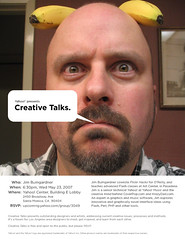
I’ll be giving a free lecture on the “Creative Use of Flash” at Yahoo! in Santa Monica, on Wednesday, May 23rd. You can get the full event details here.

This is the first installment of a “Creative Talks” lecture series that is being put together by Yahoo! creatives Jeff Hurlow and Jens Jonason.

I haven’t yet worked out exactly what I’ll be showing, but you’ll be sure to see (and hear) the Whitney Music Box, Coverpop, and various Flickr Hacks. There’s also a good chance I’ll do a card trick.

Bring your own banana hats.


My Upcoming Flash Classes

May 2nd, 2007


I’m teaching two summer classes at Art Center, in Pasadena.

For professionals with some Flash experience, my night class “Interactive Toys: Advanced Toys” (7 weeks, starting Thursday May 17th) offers a chance to learn Actionscript, and make a variety of software toys, interactive widgets and games. Visit the Art Center at Night website for more details (the course is also offered to full time Art Center students).

For high school kids, my weekend class, “Videogame Design” (10 weeks, starting Saturday June 9th) is an introduction to making classic arcade-style games using Flash and Actionscript. Although I can’t teach you to make “Grand Theft Auto” in 10 weeks, I can definitely help you make games like “Space Invaders”, “Frogger” and “Pong”. It’s a great introduction to programming and a lot of fun. See the Art Center Saturday High website for more details.

Krazydad hits NYC

April 23rd, 2007

jbum hits manhattanI had great fun presenting at the Gel (Good Experience Live) 2007 conference in NYC.

My interactive Whitney Music Box (in which the crowd made noises while host Mark Hurst controlled them with a knob) worked quite well. The audience of about 400 was game, and enthusiastically yelled “PI!” (or maybe “PIE!”) when their assigned numbers crossed the line, producing a pleasant cacophony.

The rest of the conference was awesome. My favorite presenter, I think, was Andrew, of “Songs to Wear Pants To”, a young songwriter who demonstrates that arbitrarily imposed constraints can be wonderfully productive for the creative process. Andrew composes short songs, on request, when his fans send him emails explaining what they want. His process reminds me a bit of the Dial a Song service, run for years by They Might Be Giants, and it seems to have similar benefits – Andrew has produced a cornucopia of sonic riches.

Urban Prankster Charlie Todd was also a favorite of mine. I spent much of the day yesterday playing all the prank videos on the Improv Everywhere website. I only wish I lived in New York so I could participate!

Douglas Quin’s recordings of Antarctic seals are highly evocative of synthetic sounds, and sounded like quotes from the Whitney Music Box.

I was especially jazzed to be able to brainstorm about nerdly things with fellow geek Robin Burgener, creator of the 20Q handheld game (and more importantly, the neural network that powers it).

Indeed, all the presenters had something really special to provide. There wasn’t a dud in the bunch.

Kaleidoscope #842

April 16th, 2007

A Flash-8 kaleidoscope I’ve been making today. Click to play with it (requires the Flash 8 plug-in).

The raster graphics added in Flash 8 enable larger and better performance kaleidoscopic effects than in prior versions. I’m finally able to achieve effects that formerly required graphics acceleration, such as C++/OpenGL.

I facetiously numbered this 842. Actually I’ve lost count of how many kaleidoscopes I’ve made over the years. Today I made four, but this one came out the best.

See KrazyDad at GEL conference

April 12th, 2007

I’ll be one of the presenters at next week’s GEL conference in NYC.

This is my first GEL conference and it sounds quite interesting. Each of the presenters only gets 20 minutes to speak, so we’re forced to ‘come to the nut’ pretty quickly. I’m planning on exacerbating the information-overload of the poor, addled attendees by showing about 3 years worth of material in the first 10 minutes of my slot, but I’m mainly there to present my Whitney Music Box in giant screen glory.

I’ll be demonstrating a unique interactive version of the music box in which the 400 attendees will vocally produce the sounds as I hand-crank the dots, ala variation #17. Essentially the crowd will be doing ‘the wave’ with some extra mathematics. It should be either hugely entertaining, or slightly disappointing, but on a really big scale. We’ll see.

I hope to see some of you in New York!

Who wants candy?

April 10th, 2007

An interactive mosaic of candy photos by Cybele-LA, from the Candy Blog.

Puzzle Games made with Lasers

April 3rd, 2007

LaserGamePuzzles.com is the website of Kadon Enterprises, a family owned business that builds beautiful puzzle toys to order out of acrylics and wood in their workshop in Pasadena, MD.  Most of their games consist of sets of tiles that fit together in interesting ways, such as Polyonimoes, Penrose tiles, and edge matching games using regular tilings, such as Kaliko and Dezign-8 (both shown below).

KalikotD8whiteThey also have a good collection of puzzle games for kids, including Rombix Jr, RoundDominoes, Ten-Yen, Hexnut Jr, and Bear Hugs.
Many of the puzzle games in their online catalog have interactive Flash versions, so you and your kids can try them out.

Yeah, I know what you’re thinking.  You want one of the 25-watt CO2 Synrad lasers and computer-controlled motion tables they use to make these babies. 

Yeah, me too…  Sigh…

(I originally posted this on GeekDad).