In this 3 hour hands-on class, I’ll be covering some of the advanced graphics features introduced in Flash 8, which enable you to do make things like high performance games, painting effects, motion blur, and video processing. I’ll also cover some of the techniques used to create my Coverpop website.
See you there!
UPDATE: The slides for my class can now be viewed here. Of the most interest to Flash developers will be the project files for project 1, which demonstrate (using the same magic 8 ball) 8 different ways you can get information into Flash, ranging from the simple (HTML parameters) to the esoteric (JSON via Pipes).
If you watch it long enough, especially in a dark room, you will eventually see the eye of God.
Or maybe you’ll throw up. I’m not sure.
It is definitely doing weird things to my eyes… The walls are bulging…
(Note: To install it on your Mac, just drop it into the “Screen Savers” folder inside your library folder. To install it on your Windows machine, first find a software engineer to port Quartz Composer to Windows, and then follow his instructions carefully…)
A little something I made for my students during today’s actionscript class. Here’s the flash source code, and here’s an article that explains the technique I use to generate those groooovy colors.
…and thanks to Sherrie Graham, whose quince blossoms adorn the top of my blog this spring.
You know, it’s funny how these little seasonal adornments work. I get an idea in my head that I want a little seasoning; a little sumpin-sumpin up there, and thinking there must be a million of ’em, I go to the usual places to hunt for clip art to stealslap on there, and nothing is quite right – no bare branch with a blossom is exactly like the perfect bare branch with a blossom that I have a model of spinning around in my head.
But then I went over to flickr, and searched for “branch closeup blossom” and there it was, staring me in the face! Serendipity…
While I’m on the subject of seasons, I just learned that in the US, honey bees have some kind of horrible AIDS-like disease that kills entire colonies. You know what bees are, right? Those little critters that are usually inside of those beautiful blossoms, fertilizing the plant so it can make things like, oh, apples. I’m trying to imagine a life without apples. Even scarier is the thought of life without bees. How many countless other things are dependent on them, directly and indirectly?
Feel bad yet? Sherrie has a lot of other pretty photographs. Check ’em out!
Daylight savings, whose ostensible purpose is to save energy, is an incredible annoyance to those of us in the US, and the recent changes in the system only make things worse.
If you want to find a computer that hasn’t been fixed to compensate for the three week difference in DST this year, try calling the time. Our local service, 818-853-1212, is currently providing times that are an hour in the past. I suppose this is evidence of the diminishing powers of the phone company, whose heyday was also in the past.
Feel free to use this as an excuse to be late for work tomorrow.
When I made 4,800 kakuro puzzles for this website, it never occurred to me that some of you would run out. But apparently, it’s happened, or at least that’s what the emails tell me.
If you’re a regular reader of this blog, you’ll know I’m a bit obsessed with radial symmetry. Flickr’s prolific Leo Reynolds (LeoL30) made this lovely movie out of (what else?) those round things I like so much.
Permalink|Comments Off on Breaking news: I love circles
Headlines from a BBC RSS feed are feed, via Y! Pipes, to my news ticker, which is implemented in Flash. Click on the spinning newspaper to read the story in full on the original website. This widget can work with any RSS feed, but I’m using the BBC because they tend to write short pithy headlines which fit my faux newspapers better.
Here are three Pipes-fed RSS widgets, in different styles. More to come soon…
Any of these widgets can be included in your blog by visiting this form and copying the code it generates. If your blog is extremely high traffic you might want to copy the .swf file and iframe source code and host it yourself.
One of the nice things about using Yahoo Pipes is that there is no need for me to use or implement a proxy, which makes it easy for me to make and share these widgets with other people who want to use them on their websites and blogs. The reason there is no need for a proxy is because Pipes can optionally deliver the data in JSON format. By including the JSON data as a javascript include, I can bypass the usual (and needlessly restrictive, in my opinion) cross-browser restrictions that prevent client-side web applications from retrieving XML data from 3rd party websites.
Feel free to examine the source code of this page to get a better understanding of how the data is retrieved and fed to the Flash widget. Source code for my basic news ticker can be found here.
Note: Many thanks to Yahoo’s Kent Brewster, who clued me in to the use of JSON to bypass proxy restrictions. The news tickers are using the pipe that feeds Kent’s “Badger” system.
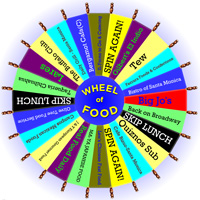
My latest circular mash-up, The Wheel of Lunch, was suggested by a paper-version created by my friend & former coworker, Geoff Ombao. The ostensible purpose of the Wheel is to prevent wearisome discussions about where to eat lunch with your coworkers or family, but it’s also a good way to discover new places to eat.
I’ve used Yahoo! Local to power the wheel. Enter your zip code and a query string, such as lunch, steak or vegetarian and the Wheel will discover many of the local establishments that fit the bill. Grab the wheel with your mouse and give it a strong yank. Then follow it’s advice or spin it again. If you want more information about the restaurant, click the description on the upper left to visit the corresponding page at Yahoo! Local.
You can also search for things that aren’t necessarily restaurants, such as bars, clubs.
You can skip the input dialog by encoding the parameters directly in the URL, like this: