Blog  |   Puzzles  |   Books  |   About

Whirligigs for the New Year

December 30th, 2005

Some people begin the new year by pledging to lose weight or quit smoking. My usual pattern is to try to find two or three new obsessions each year. Perhaps it’s more accurate to say that these obsessions find me!

This last year, those obsessions included digital photography,
photo mosaics and logic puzzles. After 20 years as a software engineer, I also made a stronger attempt to produce more works in the physical world. I subscribed to Make, took a class in electronics, started building an analog synthesizer from a PCB (it remains unfinished, but my soldering skills have improved immensely), cowrote a book for O’Reilly, and began working on some puzzle books for other publishers (all due out in early 2006). Pretty tentative steps yes, but significant progress for someone as cerebral and klutzy as this particular geek.

This coming year, there are already some new obsessions on the horizon, which hopefully will take me further into the physical world. They include:

  • mechanical clocks
  • wooden automata
  • paper automata
  • wood working

The overarching theme here is trying to understand autometa and clockwork mechanisms, by building working models out of wood and paper. As I’ve improved my understanding of the equations behindthe physics of these devices, it is compelling to try to build working models, and not just flash animations.


After visiting an amazing local antique clock collection recently, I’ve become fascinated with mechanical clock escapements in particular, and I have been reading everything I can get my hands on about this subject.

Today I ordered an interesting kit from wooden-gear-clocks.com, As a musician & programmer, I have no wood working experience at all. Young musicians very rarely get to take wood shop — they occupy the same hour in the schedule as band practice. If I follow my usual pattern, it’s quite possible you’ll see a software simulation of a mechanical clock from me instead of a working mechanical one! I’ll let you know how my wood working efforts go in the coming weeks.

Some books on my Amazon wish list include:

Krypto Kakuros

December 29th, 2005

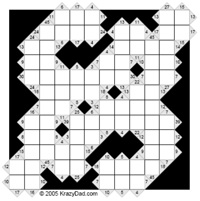
I’ve developed a new kind of puzzle which I’m calling a Krypto Kakuro. They combine elements of crossword puzzles, sudoku and cryptograms (or cryptarithms to be precise). Here are some samples for you to try.

If you aren’t familiar with kakuro puzzles, I suggest you solve a few of those first, before tackling these puzzles, which add some twists to the basic kakuro concept.

In each krypto kakuro, I’ve substituted a letter (A-J) for each digit (0-9). You must first unscramble the code before you can solve the kakuro puzzle. For each puzzle, a few of the answers are shown (also encrypted) to help you on your way. Each puzzle has a unique solution that you can find using logic and a little arithmetic.

The Original Krazy Dad

December 19th, 2005

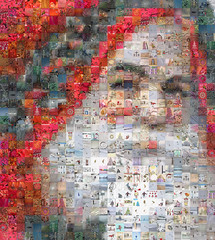
Mosaic Portrait: Father ChristmasHow krazy do you have to be to fly around the world on a sleigh and jump into a gazillion chimneys?

This mosaic portrait of Father Christmas is constructed from Flickr photos matching various christmas-related tags: snowman, wreath, christmas tree, poinsettia, etc.

This image was made using techniques I describe in the forthcoming book Flickr Hacks – due out from O’Reilly in February.

Krazy Kakuro Puzzles

December 8th, 2005

If you like my sudoku puzzles, you’re gonna like my new kakuro puzzles. Also called Cross Sums, these puzzles are like a cross
between a Sudoku and a crossword puzzle. I’ve been working on some software that generates these puzzles, and have published a set of them here at Krazydad. Each file contains 20 puzzles, and instructions.

You may notice that my Kakuro puzzles don’t look like standard issue kakuro puzzles, this
is because I’ve come up with a way to print them that preserves their symmetry. I think they look far more attractive this way, and I hope you’ll agree.

Phyllotaxy ‘R’ Us

December 2nd, 2005

Phyllotaxy Poster, 72dpi

My phyllotaxy poster has been showing up in some unusual places, other than the sides of refrigerators. Not too long ago, it showed up as part of this amusing keynote presentation by Dick Hardt, for the O’Reilly Open Source conference. Dick was talking about new web technologies, and used an early image of the poster as an example of the activities enabled by web 2.0 technologies like Flickr.

Plus, I get letters…

Dear Jim,
I just got the posters I ordered last week:  They're really
gorgeous!  (And they arrived here in Germany much sooner
than I anticipated.) Thank you very much!
Cheers,
Marco

Just so you know... I got'em and they're beautiful!  great
job.  Thanks so much for all the hard work.
-dw

Thanks so much for your quick mailing of the posters! They
are wonderful! Very nice quality! How many have you sold?
It just blows my mind that these are getting sent all
around the world!
Thanks again Jim! You are awesome!
-debbie

That’s right. Someone named Debbie thinks I’m awesome. You heard it here first.

The poster is also going to be featured in the upcoming O’Reilly book “Flickr Hacks,” by Paul Bausch and yours truly. In this book, we’ll reveal all the deep dark secrets about using Flickr to make mosaic posters, color pickers, randomized desktops, screensavers and other fun stuff.

You want a poster? I still have a few left.

Making Music with ABC Plus

December 2nd, 2005

A few days ago I went hunting for free music notation software.

Once again I was struck by the bewildering array of music software out there, clamoring for your attention. I found at least a hundred notation packages alone. I think the reason for this is that a lot of musicians are programmers, and it is common for programmers to attempt to “roll their own” software when someone else’s package doesn’t quite come up to snuff.

The sheer quantity of notation packages makes it nearly impossible for any individual to do a meaningful comparitive review that covers the whole field. Most sites that claim to provide comparisons merely provide a list of the programs that are available.

Recently I had been using a free program called NotePad by the folks that make Finale. Notepad is pretty easy to use, but it has significant limitations, because the Finale folks are hoping you’ll trade up.

I sing in a madrigal group, and I needed to notate some early choral music, which involves mixed staffs (an alternating solo soprano part, interleaved with alto-tenor-bass), and mixed time signatures (early music is often not in a strict time signature, like 4/4). Sadly, Notepad can’t handle either of these requests.

Also, I was getting frustrated with the Finale/Notepad user interface. It isn’t terrible, but I don’t think anyone has really come up with an optimal solution for entering music using windows and a mouse, and frankly I don’t need it. As a programmer, I’m quite happy to use a text editor to enter music, especially if it gives me a greater degree of control over the output.

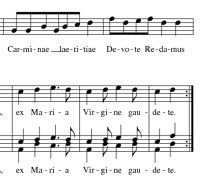
The package I finally found that does most of the tricks I’m looking for is abcm2ps, a small program by Jean-François Moine that converts text files in the “ABC Plus” format to postscript. The ABC format is a text format that was originally used for transcribing folk music melodies. “ABC Plus” adds a number of extensions to the format which enable it to be used for more complex polyphonic music, with multiple voices, staves, and so on. Here is an excerpt of the Gaudete that I transcribed, showing a soprano line followed by the Alto-Tenor-Bass response.

V: S clef=treble
V: A clef=treble
V: T clef=treble-8
V: B clef=bass
%%staves S
[V:S] ddcdfed2|dBABG2G2|GGBGBcd2|fdefd2d2|
w: Tem-pus ad est gra-ti-ae Hoc quod opt-a ba-mus Car-mi-nae_ lae-ti-tiae 
De-vo-te Re-da-mus
%%staves [ A (T B) ]
[V:A] |:d2d2c2|def2fe-|edc2c2|c2d2e2>d2|c2de2d|c2d2:|
w: Gau-de-te gau-de-te Chri-stus_ est na-tus, ex Ma-ri-a Vir-gi-ne gau-de-te.
[V:T] |:f2f2e2|fga2ag-|gfe2e2|e2f2g2>f2|e2fg2f|e2a2:|
[V:B] |:d2d2A2|dcf2fc-|cdA2A2|A2d2c2>d2|A2dc2d|A2d2:|
w: Gau-de-te gau-de-te Chri-stus_ est na-tus, ex Ma-ri-a Vir-gi-ne gau-de-te.

If you can read music, you’ll see that the notes are entered by typing note names, with various marks to indicate rhythm, barlines and so on. Once you master this form, the speed with which you can create music in a standard issue text editor
is quite fast (and faster than Finale, at least for this geek). It’s nice to be able to use cut & paste, and you get excellent
control over measure and staff placement.

abcm2ps is available in source code form, and runs on all major platforms. You can find it, and a number of related utilities and helpful documentation at the ABC Plus website. If you’re on a Windows machine, you’ll also need something to view postscript with, such as Ghostscript and GSView.

I also highly recommend the detailed user guide, “Making Music with ABC Plus,” carried on this site, which really should be distributed with abcm2ps itself.

Assorted Printable Mazes

November 23rd, 2005

I’m working on creating more printable puzzles for the site, in addition to the sudoku puzzles.

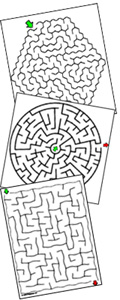
Here’s a collection of printable mazes, suitable for solving with a pencil. Perfect for a rainy day when you’ve got a bored kid in the house or office.

The mazes come in 5 different difficulty levels, ranging from easy (for young kids) to “super tough,” which are really only
appropriate for masochists, obsessive compulsives, and robots. The mazes come in a variety of shapes & styles.

If you’re interested in how I generated the mazes, check the maze section in my Flash Bestiary. I basically took that code, ported it to Perl, and modified it to generate PDF files.

Non Transitive Dice

November 18th, 2005

These 4 non transitive dice are one of the great illusions sold by British Toy & Magic Shop Grand Illusions, which specializes in mathematically-based novelties.

Ask a friend to choose a die, you choose another. Make ten throws, and you will win the majority of the throws. No matter which die your friend chooses, you can choose another which will beat it, even if he chooses your last “winner.” I find this baffling!

Take a look at the die layouts to see why it works:

My Lobotomy

November 17th, 2005

I heard Howard Dully’s personal story about his transorbital lobotomy, 45 years ago, on the way
home today, while listening to NPR. This chilling and emotional tale, in which Dully finally confronts his father about the operation which ruined his life, makes up for 9 months of horrible music cues and pledge breaks. This is why we have NPR.

Did you miss it? Listen to it at NPR.org.

Wacky Collages

November 11th, 2005

After seeing my Wacky Packages Coverpop, astronomer John Dubinski wrote to share with me his amazing
large-scale photo mosaics of Wacky Packages
(and also take my ego down
a few notches, by demonstrating his superior geekitude).

These are the most accomplished photo mosaics I have seen to date, involving random image placement of images with unusual shapes and rotations. They are particularly impresssive because the intial set of images that John is working with contains only 512 tiles, and yet he is getting excellent image fidelity – you can even read the writing on these packages!

John has written a parallelized program that produces these on a 4-node 2 GHz Athlon cluster, and they still take about an hour to produce.

So there you have it. A giant can of “AJERX” as rendered by an astronomer working in the field of parallel N-body simulations and galaxy dynamics. Another geek reaching his true potential!