Stereo Harmony
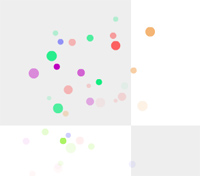
August 7th, 2006This weekend, after adding stereo support to my software synthesizer, JSyd, I added three new stereo variations to the Whitney Music Box. These are fun to watch and listen to with headphones.

|
|
 |
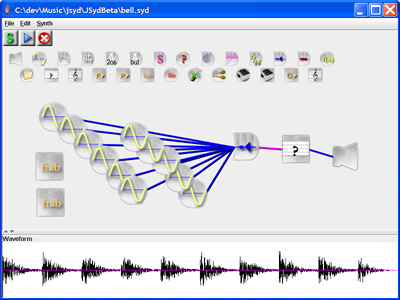
Stereo HarmonyAugust 7th, 2006This weekend, after adding stereo support to my software synthesizer, JSyd, I added three new stereo variations to the Whitney Music Box. These are fun to watch and listen to with headphones. Free Sounds, Pictures and SoftwareAugust 3rd, 2006Some useful links I’ve collected recently. Morguefile is a collection of free high quality digital photos. I’ve used them for building mosaics with excellent results. FreeSound is a collection of free sounds, licensed using the Creative Commons License. ccMixter is a related site which collects songs, rather than individual sounds. I’ve been looking for interesting free audio programs for use in my upcoming Art Center class “Digital Audio and Sound Effects,” for High School kids. My base criteria for the software used in this class is that it must be free (or in beta, or demoware) and it must work on both PCs and Macs. Some of my favorites: Audacity, a free audio editor. JSyd, my own software synthesis program. Plogue Bidule, an audio and MIDI processing app, especially useful for live performance. Rebirth, Propellerhead’s retro-synthesis program is now free (but doesn’t work so hot on Mac OSX compatible). Know any other good ones? Let me know. I’d like to find a free program that does decent TFFT displays (spectral changes over time). WavePad does this well, but is PC only. JSyd – Java Software Synthesizer- Now in BetaJuly 27th, 2006You may have noticed that I haven’t been blogging much the past few weeks. This is because I’ve been furiously working on a rewrite of my software synthesizer, Syd, originally written nearly 10 years ago. Syd is a digital music program that is designed for teaching basic computer music and synthesis concepts. I used Syd to generate many of the more interesting music variations in my Whitney Music Box (especially those involving harmonics and microtones). The new version, written in Java, is called JSyd. It runs on Macs, Linux boxes and Windows. You can download a beta version of it here, and read the (sparse) documentation here. Here’s a screen shot.
Here are some sample sounds produced with Syd: Sample 1 If you are on a Macintosh or Linux box, I’d be particularly interested in getting your feedback & bug reports. Thanks! UPDATE: My coverpop website has been having some power-related outages today – I’ve temporarily moved the Syd files to a different location. Crank Me!July 26th, 2006Follow this link for a little more hand-cranked goodness. ApophysisJuly 21st, 2006
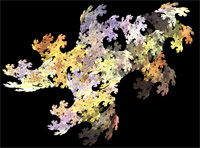
It’s an IFS fractal program capable of some gorgeous organic looking results. I first encountered IFS fractals in Michael Barnsley’s book Fractals Everywhere. Wikipedia says they were first developed by John Hutchison. Favorite PostsJuly 7th, 2006
Since I haven’t bothered to collect them elsewhere, I thought I’d post them here. Got your own favorite? Let me know, and I’ll add it to the list. MIDI Scrapyard challengeJuly 6th, 2006My favorite Los Angeles art gallery, Machine Project, is hosting a MIDI Scrapyard Challenge this Sunday, and I’ll be participating. Want to convert that old blender into a MIDI instrument? This is the time and place to do it. An all day workshop will be followed by a performance using newly created MIDI instruments, resurrected from old electronics junk, at 7pm. Come join us for the performance at 7 pm! I hope to provide some MIDI-powered circular goodness. Jos LeysJune 29th, 2006
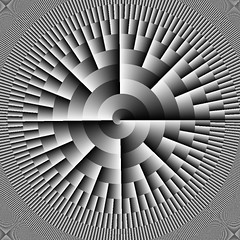
Jos Leys is an expert user and programmer of the fractal imaging software Ultra Fractal. If you like circles and radial symmetry as much as I do, you will love his mathematical image gallery, which is filled with all kinds of circular goodness. Wheel MusicJune 21st, 2006
Each dot in the animation represents an individual note you are hearing. The notes are slowly traveling around in a circle. Each square represents a different tone cluster, or chord. Colors represent note values, and the radius of the circles is loudness. The “Wheel” in Wheel Music is a recurring theme in a lot of my pieces, which often involve circles, oscillation, and radial symmetry. The cylindrical pattern that the notes form is reminiscent of a barrel organ, one of a handful of automatic instruments which this piece is intended to evoke, others being player pianos and wind chimes. I made Wheel Music using various technologies, including Python, Syd, and Flash. The score was generated using a Python script which generates note values and outputs to them to a text file in the SKINI format (similar to MIDI but more flexible). My software synthesis program, Syd, was used to render the audio score as a WAV file. I wrote another script which converted the SKINI score into an actionscript array, which I used to render the animation in real time in Flash, the animation is a literal rendition of what is going on in the score. Mac & Cheese Fibonacci SpiralJune 15th, 2006
Krazydad Irregular Ryan Govostes writes:
I’m still hoping to acquire a photo of this magnificent phenomenon, but in the meantime here’s a guess: The fibonacci spiral is the optimal way to pack circles in a round container – each circle gets the maximum amount of space. So, when the water heats up, the noodles are going to jostle and push against each other and find that optimal packing, kind of like corks floating in a bowl. |
|