Goodbye, Gyorgy Ligeti
June 12th, 2006 One of my favorite composers, Gyorgy Ligeti, died this morning at the age of 83.
Time for a little Lux Aeterna.

|
|
 |
Goodbye, Gyorgy LigetiJune 12th, 2006
Time for a little Lux Aeterna. Tag Cloud TipsJune 10th, 2006What are Tag Clouds, you ask? Here’s a sample. I’ve provided some tips for building Tag Clouds at O’Reilly’s ONLamp website. This is an excerpt from my longer article, Building Tag Clouds with Perl and PHP. Google US Puzzle ChampionshipJune 10th, 2006Registration is now open for the Google US Puzzle Championship, organized by Nick Baxter and Will Shortz. Players have 2 1/2 hours to complete 25 fiendishly difficult puzzles. Mosaic BlossomJune 8th, 2006
I’m currently working on a series of mosaics using landscape and animal photos. Here’s a sample. UPDATE: I received a letter about this image. Here it is.
My answer:
Petals around the RoseJune 3rd, 2006Petals around the Rose is a puzzle in which you must figure out an underlying system based on the roll of 5 dice. It took me about an hour to figure it out. Some people get it right away, others take months. Here are two versions. Virgin TerritoryJune 2nd, 2006
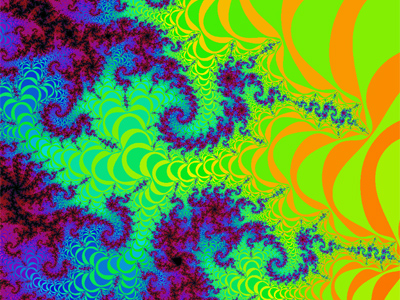
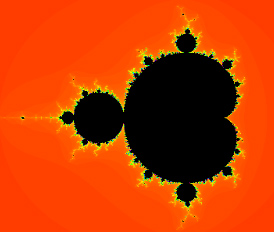
While on a morning coffee run with a coworker, we chanced on the subject of religious experience, and I mentioned that exploring mathematics is the closest I’ve come to a religious epiphany. Although this notion is probably familiar to folks versed in the physical sciences, my friend was surprised to hear it. I brought up fractals made with complex numbers as an example, and was pleasantly surprised to find that my friend was unfamiliar with them. On getting back to the office, I fired up a windows program I had written a couple of years ago.
“No,” my friend said, “it looks kind of like a Buddha!”. My heart skipped a bit as I realized I was in the presence of a Mandelbrot virgin. There was only one thing to do. Zoom in! So I pressed the left mouse-button and proceeded to give my friend a guided tour of the hidden buddha-nature of this complex landscape. It is always a pleasure to introduce the Mandelbrot set to a newbie. Zooming into it for the first time is like opening up a fresh jar of wonder. My program exploits the acceleration on modern graphics cards to do fractal zooms in real-time. You use the left-mouse-button to zoom in, and the right-mouse-button to zoom out. There are various other keys that do things, but that’s all you really need. As I explored and explained some different locations in the mandelbrot set, my friend sat there and said “Wow!” repeatedly, as unjaded Mandelbrot virgins are wont to do. This was also a good time to explain the bizarre concept of “imaginary numbers,” so I made a stab at that too. I must admit, I still find imaginary numbers damnably counter-intuitive. I’m just glad they make such pretty pictures! The only other time I’ve encountered them in my work is in making pretty music – they are also used in audio effects processing. Later, when my friend asked for some links to some software for exploring the Mandelbrot set, I had a hard time (using Google) finding software that does these kind of continuous zooms (although I’m sure there is lots of it out there). There is tons of Mandelbrot software on the Internet (writing such programs is a common hobby for newbie graphics programmers). The heydey of Mandelbrot exploration was probably the late 80s and early 90s. The problem is that a good deal of the Mandelbrot software that is out there and easiest to find was written some years ago, and is designed to generate still frames only. So there’s a lot of noise covering up the good stuff, and a need for simple programs with more intuitive interfaces. Then there’s my software. Even though it’s a bit half-baked and completely undocumented (I just wrote it for my own use), I thought I’d provide it here, for those that lack a suitable substitute. If you have a friend that is a Mandelbrot virgin, you too can add a little wonderment to their world. Here is my program, MandelZoom. Like I said, windows only. MandelZoom supports the following commands, which are single keystrokes:
There are a few other hidden commands in there (+ – [ ] space), which I’ll leave undocumented, for messing with the colors. You’ll figure them out if you dig. Although this is a windows program, the source code is fairly portable. At some point I’ll get around to putting up a Mac executable. If you’d like to compile it on another platform, and you’re familiar with OpenGL/GLUT programming, here is the source code. Don’t try this if you’re not an experienced programmer. I love getting your emails, but it is not a good medium for me to teach you C++. :) If you manage to do a successful port, let me know, and I’ll link to it below, when I update this post. No doubt, there are much better programs out there, with the same real-time zoom capabilities. If you know of them, please tell us in the comments, and I’ll mention the better ones below as well. UPDATE: Krazydad irregular Ryan Govastes points us to a more full-featured cross-platform program called Xaos. Oooooh. Smooth zooms! The first of many, I am sure. Krypto Kakuros in Games MagazineMay 26th, 2006
Welcome puzzle solvers! If you’re visiting Krazydad because you want more puzzles, you’ll find ’em here. Also, you may enjoy the various offerings in the fun & games section. Processing Group at FlickrMay 26th, 2006
The Processing group at Flickr contains a gallery of stunning images created with my favorite language for making motion graphics and algorithmic art: Processing. As I’ve mentioned before, processing is an excellent first language for budding algorithmic artists. Clouds, clouds, everywhereMay 24th, 2006When I told my family I wrote an article about tag clouds for O’Reilly, they went “Huh? What’s that?” But then again, these are the same folks that thought I was writing an article for this guy, instead of these guys. Anyway, this is a tag cloud: 2d algorithmic ALSA audio automatic bison blog book books computer cool dev development dick digg effects ephemera filter flash forum game generator generators graphics java kids languages link lisp mathematics midi music newspaper nyquist parser pdf php piano pkd programming rails reference rendering rss ruby search sf sfront skini software stk syd synaesthesia toy vector whitney xml This particular tag cloud is a map of my interests for the past few weeks, based on the bookmarks I have been saving to my del.icio.us account. My new article, “Build Tag Clouds in Perl and PHP,” shows you how to build one of these amorphous wonders for your website. More importantly, it shows you how to use them effectively, and it contains the word “pie.” Doesn’t get much better than that. Here’s the official blurb:
The Shape of SongMay 24th, 2006
Martin Wattenberg’s The Shape of Song provides a series of graphic analyses of MIDI files. The arches link musical phrases that are repetitions of each other, and provide a striking guide to the structure of the music. The above image is Madonna’s “Like a Prayer.” The site contains images of varying styles of music ranging from Bach to Philip Glass. Link courtesy of Darryl Handy. |
|

 “Look at this shape. Have you seen this before?” I asked.