

Puzzles and the AI Software Glut
I have been making and publishing puzzles online for over twenty years at krazydad.com (this very website). Over that time a lot has changed, but one thing that has not changed is the size of my audience, which has remained remarkably constant, as this graph of human traffic from the last five years attests.
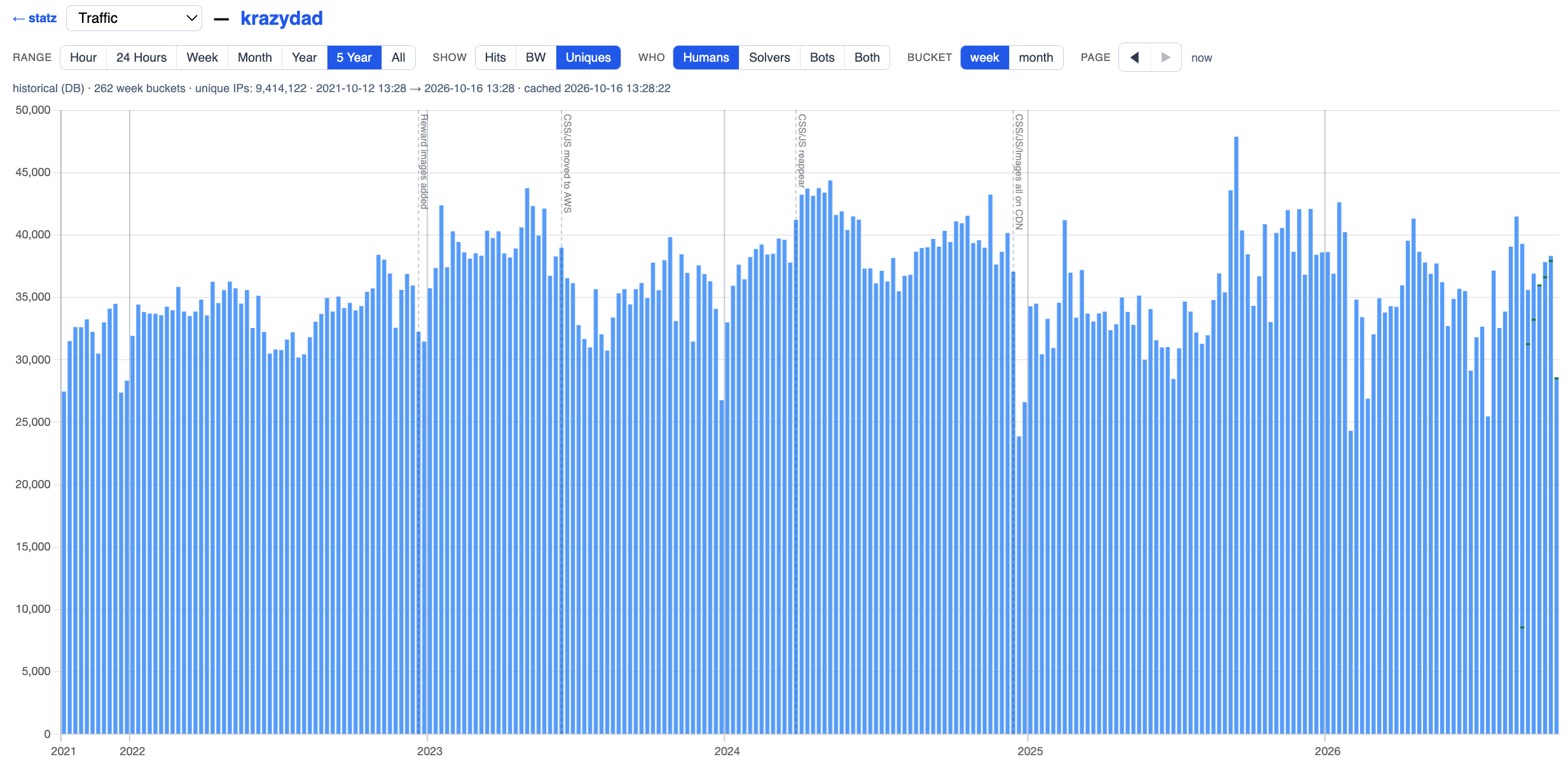
There’s a reason for this: I am explicitly not trying to grow it! I am just trying to keep it about the same, so when I see it shrinking, I occasionally take steps to address the situation.
For example, once upon a time, the site only provided printable puzzles. When I saw the audience for printable puzzles was shrinking, I added support for interactive puzzles. This was about eleven years ago. At the time, it seemed like interactive puzzles were on track to significantly overtake the printable puzzles. As of late, I am seeing a reverse trend, as more and more people “unplug” and do the printable puzzles instead. I don’t mind this. Interactive puzzles are much harder to produce (even though there is an odd perception that printable puzzles, being tangible, are “worth more”).
Obviously, my “keep it steady” approach is counter to the way most small businesses work, but this site is as much a hobby as a small business. I wish to continue to enjoy working on it. If the site had twice the audience, I would probably have twice the headaches, and would enjoy working on it less! So I don’t mind having a fixed-size audience. To me, steady growth seems like a cancer; it is ruining a lot of things we hold dear, and I just don’t want it for a hobby site.
I am here to talk frankly about “AI” (or what we currently think of as AI — the meaning of that term has changed significantly since I first started encountering it, in the 1980s), and how contemporary “AI” has affected the way I make puzzles, and the puzzle marketplace in general. I think a lot about the puzzle marketplace, and I suspect my observations about this very specific, niche marketplace probably apply to several other markets that are also affected by AI.
I would like to think my observations in this post will be “nuanced” and will neither be “pro” nor “anti”. I am also deeply aware that the general public is somewhat polarized on this topic, and that there are a lot of reductive opinions out there. I beg you to keep an open mind as you read this! I have some good things to say, and some really bad things to say, and some observations about the general disruption currently underway.
I am about to self-publish, via Amazon KDP, a new book of Killer Sudoku, called “Cereal Killer Sudoku”. The puzzles are produced using essentially the same methods I have used for 20 years — I write software, and the software makes puzzles. This is no secret. My website has over two million free puzzles on it. I simply don’t have the time to produce that quantity of puzzles manually! Using power tools, like the software that I write, is the only way I can achieve such numbers. I would like to think that the puzzles I publish are high quality, and I take great care to ensure that they are accurately measured for difficulty, to the extent I can do so, and that they are fun to solve, and have unique solutions. Some of these puzzles, such as the Cross-figure puzzles I recently published, would be incredibly tedious to construct manually. I have talked about these methods at length in my recent YouTube videos.
There are certainly plenty of people who believe that manual construction by humans is the only proper way to make puzzles. Clearly I am not one of them! Sudoku has been very popular since the 2004 craze, and in all that time, the majority of newspaper sudokus have been computer generated. The solvers don’t seem to mind! Moreover, I have made some astoundingly cool puzzles using software, like my recent book of “Kaleidoscope puzzles” which use a wide variety of interesting tessellations.
My puzzle making software (apps and scripts), all written by hand until recently, would have been considered a type of AI, back in the 1970s, back when we thought of chess software as a kind of AI, but at the moment, when we say AI, we are generally referring to “neural networks” — or “models” which are collections of vectors, which mimic, in a crude way, the workings of a biological neural network. And more to the point, we are typically talking about frontier-class models, like the ones made by OpenAI and Anthropic. And not the models used for more prosaic tasks, like classifying emails into spam and not-spam. My puzzles are not produced (directly) by such LLM or generative models, they are produced using much simpler programs, that I’ve written in various languages, including C++, Perl and Python. But more and more frequently, I am using coding models and coding harnesses (such as Claude Code) to aid in the production of such software.
When I publish that forthcoming Killer Sudoku book, Amazon is now going to ask me if “AI” was used to produce the book, something they didn’t bother asking for all my prior books. I am probably going to say “No”, because in my opinion, the purpose of that question is to determine if the prose and other significant content of the book is “made with generative AI”, and I believe in the sense they mean it, my work is not produced by AI. Nonetheless, the real answer is truly complicated (and the question is simply not nuanced enough)! I believe this question was designed for the vast majority of KDP authors, who are writing prose fiction. They want to know if the prose was generated by AI. In short: Is it an “AI Book”. The puzzles in my puzzle books have, for many years, been produced by software that I write. Does that make them “AI” in the same sense? I don’t think so. Most of them were produced prior to the current AI boom.
However, like most other software engineers I know, the nature of my workflow has changed significantly over the last two years and continues to evolve quite drastically. I am like an Amish carpenter who recently got access to a workshop full of power tools. I generally don’t touch the code anymore. I do use AI to help write the scripts that produce the puzzles now, by giving it a very careful series of prompts, which are honed by my 30+ years of experience. I don’t think what I am producing is “AI Slop”, or what I personally think of as “AI Slop” (which I would define as “content produced by non-experts with bad taste, using power tools”), but you are welcome to disagree. In my view, not all AI-assisted content is “slop”. When the AI announces itself loudly, as so much slop does, we are entering into slop territory. But note: another way that AI announces its presence is by sheer quantity, which is the topic of this post.
I will continue to use power tools to produce puzzles, as long as they are available to me, but I am never going to ask the “AI” to “make a bunch of puzzles” without being super explicit about the algorithms used, and the types of solving methodology, difficulty measurement etc. I can’t and won’t do “one-shot” prompts to produce puzzles. And for what it’s worth, I really don’t like to publish or share AI-generated prose (because I don’t like receiving it), and this blog post is straight up me, Jim Bumgardner, typing with my actual fingers, into a text editor. I will probably use AI to spell/grammar check it though, just as I have used spell checkers in the past.
So what has my increasing use of AI power tools done for the krazydad website? Frankly, it’s made it significantly better!
In recent weeks I have significantly streamlined the user interface, I’ve added step-by-step solving instructions to my most popular puzzles, I’ve weeded out some bad puzzles and replaced them, I’ve added some new puzzle varieties. I’ve finally published a much better set of mazes, something I’ve been wanting to do for years, but only sporadically worked on. I’ve added dozens of little long-needed tweaks to the site. It is a significantly better website than it was a year ago.
All these little improvements are things I’ve been wanting to do, in some cases for over a decade, but didn’t have the time and patience to work on. Bear in mind this entire puzzle endeavor is a side-project for me. I have a day job, I have a family. I don’t have tons of time to work on the puzzle site.
By my own estimation, the number of new features introduced on the website in the past 3 or 4 months greatly exceeds what I had managed to do in the prior 5 years! A few of these improvements can be seen in my home-page announcement:

But at the same time, AI power tools haven’t just made it easier for me! They have made things easier for everybody, and I can see it. I would estimate, just based on my correspondence, and a cursory overview of several Reddit puzzle-related threads, and Amazon bestseller listings, that there has been a roughly ten-fold increase in the number of puzzle websites, puzzle apps, and new puzzle varieties since January of 2026. All pretty clearly due to vibe-coding. A good example of this is the recent plethora of “Alice is not the killer” style books showing up in the Amazon logic puzzle bestsellers. This type of book is easily churned out by AI, and I have seen maybe 100 of them in the wild. Just that one type of book!
And it’s not just puzzles. Any type of software that can be churned out by AI is seeing a huge increase in supply. This includes malware and bots!
I can also see it in my weblogs. There has also been a ten-fold increase in the number of non-human visitors to my website. Check out this five year graph of non-human traffic, you can see it!

That graph is revealing the massive up-tick in the number of bots trying various exploits, as well as secret web scrapers pretending to be humans. The bot traffic currently accounts for about 90% (some days 99.9%) of the traffic to my site). I am constantly in an arms race with detecting these guys, so I don’t accidentally ascribe the traffic to humans (and for what it’s worth, I don’t think Google Analytics is very good at making those distinctions, and it probably benefits Google to keep doing a shitty job in that arena. I finally got off Google Analytics a few weeks ago, in favor of analyzing my own weblogs). When I do a more careful job of weeding out the non-humans, I can see that the actual human traffic to my site is about the same as it has always been. About 7k – 9k unique visitors per day. Demand is about the same.
My point is: we are seeing a glut. An increase in supply that is not met by a corresponding increase in demand.
In my particular case, I clearly see a glut in non-human traffic to the site, and in the puzzle marketplace, a big old glut in supply of puzzles. That glut isn’t going to make people want puzzles any more than they do! If anything, all those casually vibe-coded puzzles may make people want them less! Right now, this glut isn’t causing me to gain or lose traffic (at least not yet). I am not an economist, but this feels like economics 101 stuff. It’s a glut, and it’s not just puzzles! It is everything that is easy to make with AI. It is every kind of software that AI unlocks for people.
And the value of all that software, because of the oversupply, is heading towards zero. A big fat zero.
I don’t think AI is directly to blame for this. I think this is the inevitable long term nature of software in general. It must lead to over-supply. I myself have certainly contributed to the devaluation of puzzles by publishing so many of them without power tools. AI is merely accelerating it.
The ability for people to charge money for software, or software services, will soon be over. The hackers once said “Information wants to be free”. I, a once and future proud hacker, am saying “Information can only be free” and AI is helping to accelerate that.
We are headed towards a future where all software will have no value. If you want an image editor, or a video editor, you will be able to spin one up, kind of like Captain Picard ordering Earl Grey tea at the food replicator, and then you will consume it, and then maybe just throw it away! The software-as-a-service business model is over.
So what does that mean for the economy? What does this massive forthcoming AI glut mean for you and me? I think it might be useful to take a look at some historical gluts to see. A fairly recent one is the availability of cheap stock photography. Following the rise of digital photography, the value of stock photography sank. It was no longer a viable career option for a talented photographer to make a living selling stock photography. All the stock photography money ended up in the hands of a few very large companies that were willing to deal primarily with lawyers and licensing terms. The content itself became essentially worthless. Perhaps you know of some other gluts you might want to take a look at? Maybe tulips?
In a glut, the only people with leverage are very large organizations with deep pockets and a lot of lawyers, as well as companies that own established brands. I don’t think there is much of a role for middle class individual contributors, like myself, in a glut economy.
I also believe that gluts are particularly toxic for capitalist economies. I believe we will need to transition to something different, possibly a more socialist economy, in order to avoid the truly toxic effects of the more massive gluts that are coming.
I am fortunate that I have a small 20-year-old puzzle brand. I hope I will be able to retain my audience a little while longer, but I can see this state of affairs is not going to last long. Maybe it will? We’ll see.